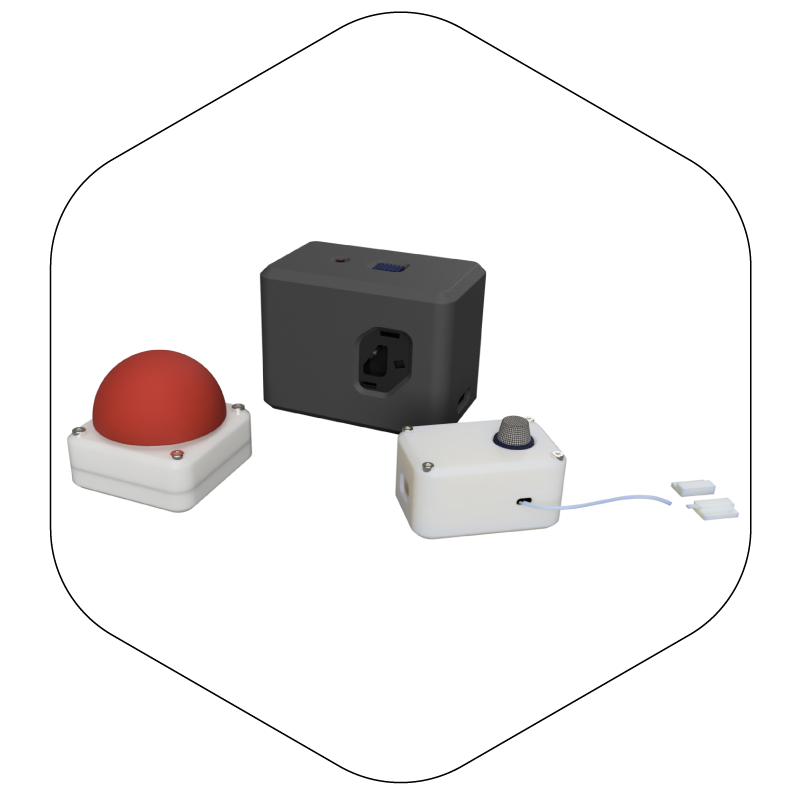
Academic Portfolio

Welcome to the main section of my academic portfolio!

Throughout my Master studies in Industrial Design, I participated in different projects and courses that helped me develop different skills as a designer. All the learning activities include a small description and the main competencies I developed. For further reference the work and reflections can be accessed through the links.

DCM100 Constructive Design Research

In collaboration with: Axel van Boxtell, Chia-Hsiu Liu, Evie van den Munckhoff and Maarten Marks.

Description

This course provides a basis regarding design research and how to carry it out. By using a prototype as a research tool, a designer can study and gain meaningful insights regarding a specific topic. For this course we researched the effects of voice feedback in Sensiri, a smart coffee machine.

Design Research Processes

In this course I learned about three design research approaches: Lab, Field and Showroom. Throughout this course I learned about the strengths and weaknesses of each method and when to apply a specific technique to gather the best results.

Professional Skills

I collaborated on the planning and the setup of the research. I also learned how to deal with scientific information and to show results in a condensed yet informative way.

DCM160 Interactive Materiality

In collaboration with: Arnout Bakvis and Lisa de Vries.

Description

Aesthetic interaction is a design approach that is focused on aesthetic experiences which are used throughout the design process. In this course these notions are explored by looking at the inherent qualities of certain materials that are then used to create these interactions.

Creativity and Aesthetics

In this course I studied several types of materials and looked at their properties. Based on these qualities we designed an aesthetic interaction and then developed a smart material with these notions. I also was responsible for the video editing to show the design process and the end result.

Technology and Realization

I designed and configured the layout of the box demonstrator that would show the interaction with the design we developed. I configured the LDR sensors and motors to move the material and respond to hand contact.

DPM110 Project 1: Harmony

In collaboration with: Bram Rolvink and David Qvist

Description

An interactive smart product family designed to prompt family interactions. The system helps to organize and plan activities inside and around to promote housekeeping in a smart home.

Technology and Realization

In this project I prototyped a watch that would connect to other wearables using OOCSI. This is a platform where designers and researchers can develop connected products and systems using C++ and Java functions. Furthermore I prototyped different iterations to explore the light interaction and connectivity of the product family.

Creativity and Aesthetics

With my team we used different idea generation methods in which we would explore and analyze ideas rapidly through sketching. In this project I also took a look at Design Sprints and learned how to apply it in this project. 

User and Society 

Through the design process multiple user tests were performed using different settings and methods. First the light interactions were evaluated in a lab experiment and a second prototype was deployed in the field at a family’s home.

Math Data Computing

In this project I learned about handling data streams that were processed through OOCSI. With this tool I used incoming data to program product behavior and was able to interact with other products by using the incoming data.

DDM150 UX Theory and Practice

In collaboration with: Seiji Bernabela, Alex de Kruijf, Emma Reiling and Zhiping Zhang.

Description

Multiple activities through the course and assignments were used to explain the notions of User Experience (UX). Company visitors demonstrated how to involve the user in different stages during a design process and one of them offered a design case. 

User and Society 

As a designer I learned how important empathy is when designing for the UX. I learned various methods that designers can use to get insights from users to improve the design and provide added value.

Business and Entrepreneurship 

I worked with a group of students in a design case given by a representative from Van Berlo. I learned about their approach on how to define UX goals to guide the design process.

Creativity and Aesthetics

Based on the UX goals that we defined. I designed one of the interactions that would focus on the playfulness aspects of the design. Furthermore I worked on a poster to highlight that designers should focus on UX and not on adding features.

DBM110 Complex and Adaptive Systems

Description

Systems that are formed by agents that interact or adapt dynamically are called complex adaptive systems. The goal of this course is to learn to create prediction models based on the behavior that these agents have. For this course I made a simulation model to predict how drones could act if they are deployed at random in disaster situations.
Math Data and Computing 

In this course I learned how to program the behavior of multiple agents and their interactions called NetLogo. I was also able to find trends and analyze the results of the system .

Technology and Realization

I learned a new software called Netlogo that is most commonly used to develop agent-based models. I learned how to use the different functions that the program offers to generate the model and graphs for the analysis.

DPM120 Project 2 Design Research: 

How to look at home activities?

Description

Through this design research, I investigated how people implement technology based on their activities in smart homes. Based on this research and a smart home HTI framework, I proposed a new framework for designers: To look beyond the individual UX and observe how routines and activities can influence the co-experience and thus the design process.

User and Society

Through this research I learned to set up and carry out semi-structured interviews with multiple participants. This was the first time I carried out qualitative research and I learned the strengths and weaknesses of this type of methodology. Furthermore, I learned to identify and ask relevant questions to find meaningful results while interviewing participants.

Design Research Processes 

During this project, I learned to use affinity maps to find similarities and common topics among participants. Through this project I also learned to formulate specific research sub-questions through multiple iterations which guided my research process even further. I also learned about relevant design issues regarding smart homes and new design aspects such as co-experience.

Professional Skills 

In this project I learned about the importance of a research question that is clear and easy to communicate. Furthermore, this was the first instance where I learned to do an entire research process individually. I also learned to set up a research paper and I was able to relate scientific knowledge to my own work. 

2IMN15 Internet of Things

Assignment in collaboration with: Bavo Coremans

Description

This course provided a solid theoretical foundation regarding the Internet of Things. Several concepts such as system architectures, protocols, device classes, types of applications and examples were explained. Through the assignment I started with basic data analytics and processing using Python.  I hope to deepen my knowledge of this topic at a later stage in my career.

Math Data and Computing

Learned about different concepts of IoT networks and architectures. I also learned to analyze and define how a network of smart products is composed based on current market products. Additionally, I learned to process data using Python libraries such as numpy and pandas.

Technology and Realization

Through this course I learned about a new programming language, a number of functions and libraries to process and analyze data. This course sparked my interest in data analytics. During this course I also learned important concepts from computer science that I was not aware of such as network architectures and styles.

DBM160 Data-enabled Design

In collaboration with: Yaël van Engelen, Pablo Traversat and Lieke Vermeulen.

Description

The course Data-enabled Design introduces the methodology of the same name where data is used throughout the design process. The method can be divided into two parts: a contextual and an informed step. During the contextual step the designer gathers information about the context using sensor data. Based on the collected data a design is then introduced. Next to that, the user is involved in both stages of the process.

Math Data and Computing 

In this elective I looked into different ways to make visual data representations to describe occurrences in the context of our design case. By using these visualizations it was possible to observe the events and their effects.  

Technology and Realization 

I was actively involved in the design of the data probes and chose the necessary sensors for our research topic. I also configured the software of the probes during the contextual step using the microcontrollers, OOCSI and DataFoundry.

Business and Entrepreneurship

I learned about how this method is used in the industry throughout different design cases. Additionally, I learned from guest speakers about the method and how it is being used currently in the development of new products.

Design Research Process

With this course I understood how to combine my strengths as a designer to gain valuable input in my design process. By developing data probes and involving users early, I can get a detailed picture of the context and potential design problems. Through the same data probes, I can validate the design by measuring the effects.

DFM215 Project at Industrial Design (FE): ECU Meter

Description

As my preparation project, I collaborated with a cardiologist from the Maxima Medical Center (MMC). Patients who suffer from Cardiovascular Diseases (CVDs) need tools to help them monitor their salt consumption. Therefore, I designed a measuring device to help these patients measure their salt intake. Throughout this project I researched and validated the preliminary design of the cup.

Math Data and Computing 

I researched the effects of Electric Conductivity (EC) and the possibility of using it to measure salt consumption through urine samples. I analyzed how external factors can affect the results and searched for a viable method that could be used with simple microcontrollers and could be adapted into the design.

User and Society

I carried two usability tests with male and female participants to improve the design of the preliminary cup. Due to ethical concerns, the test involved a role-playing exercise, interview and a System Usability Scale (SUS) questionnaire for evaluation. Based on the results of the questionnaire I could determine if the modifications were effective or not.

Creativity and Aesthetics

Because urine sample collection is a common problem for people, I made sketches using features from market products which are simple to use. I also made a visualization of the final concept.

Technology and Realization

Based on these initial explorations, I made 3D printed exploratory prototypes to study the form and its effect when collecting liquids. Then I printed a preliminary cup that could fit in the toilet for user testing. After user testing of the preliminary model, a Minimum Viable Prototype was produced to address the issues that were found during the usability tests.

Business and Entrepreneurship 

I performed a patent search to evaluate if the idea was original. If the idea already exists and there is registered Intellectual Property (IP) the idea cannot be freely produced and marketed which discourages businesses.

Professional skills

This project was a big stepping stone for me as a designer. I showed that my communication and reflection improved and this could be noticeable on the quality of my individual deliverables.

DFM220 Final Master Project (FE): MeasureEat!

Description

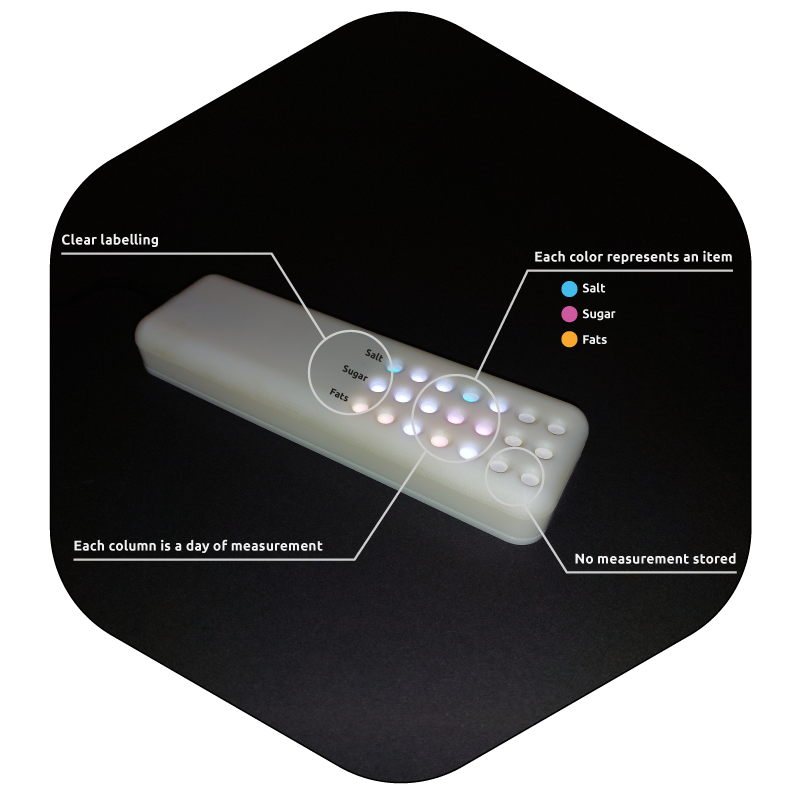
This project was made as a continuation of the preparation project. The cup that was developed on the previous project would only record the EC, however the information was not displayed. Furthermore, the use case for the system currently support salt measurements, but it can be extended,  to measure other food additives through urine samples, mainly sugars and fats. Considering that there are no user-friendly devices to measure in urine samples, a design has been proposed. The system is composed by a visualization device and a measuring cup that measure salt. Based on the performed usability tests, a design recommendation has been made for future research on how the sensors can be extended to measure glucose and pH and to make the design of the cup robust, for future usability tests.

Math Data and Computing 

During the FMP I programmed a system that can measure and display salt levels and can be expanded in future iterations to measure other parameters. I learned about new types of sensors that can read glucose and pH levels that could be researched in future iterations. Furthermore, I learned about the science behind these sensors and learned about some limitations of the technology. For instance, that the glucose sensor would need to be recalibrated after a certain period of use. 

User and Society

I looked at the societal impact that chronic diseases have and learned about how dietary behaviors can increase the incidence in contracting these diseases. I also learned what my role as a designer is and that I can have influence on the problem and people’s behavior through design. I developed a new usability test setup considering the system would be tested in the field and it would happen remotely. Next to that, I did interviews with target users to learn from their experience, empathize and create a patient journey through the development of a chronic disease. 
 
Technology and Realization 
Based on the research of sensors, I made a design recommendation to extend the capabilities of the sensor. I also fabricated the device that would communicate and store the time and measurements from the cup. Additionally, I programmed a demo of the panel with multiple readings for visualization purposes. I also made a cost analysis of the design.
 
Business and Entrepreneurship
At the start of this project I looked for companies to collaborate to develop the cup. I searched for current market products and saw if there are possible competitors for my design. During the retake I learned what the role of MVPs are and how they are used throughout the development of new products. During the retake I evaluated how my design does not fit an MVP criterion, but explained how the proof of concept can be researched further to reach an MVP status. 
 
Creativity and Aesthetics 
I improved the quality of the report by making it visually appealing. I made sketches during the ideation phase of the feedback device and the visualization of the concept was adapted to include the whole system. I improved the quality of my work in terms of the design of my report and house style. Through the retake, I improved the design of my online portfolio and included more visuals that show my deliverables.
 
Design Research Process
Through this project I learned about the complexity of designing medical products. There are multiple considerations that need to be made from an ethical and legal perspective.